The overlooked role of optics in automated inspection
Machine vision has become a core part of modern manufacturing inspection, with Gartner predicting that by 2027, half of warehouse operations will rely on AI-enabled vision systems rather than conventional scanning-based cycle counting. The quality of the data generated by these systems begins with their optical components. Regardless of how sophisticated the software is, poor image data will ultimately limit performance.
Managing unwanted optical noise
Automated Optical Inspection (AOI) systems rarely operate in perfectly controlled environments. Natural lighting varies throughout the day, overhead factory lighting can be uneven and highly directional, and many manufactured parts contain reflective surfaces. As a result, unwanted light often reaches the sensor alongside the information the system is intended to capture.
These variations can reduce repeatability, introduce intensity fluctuations, and create colour inconsistencies. Reflective materials can also generate stray light that obscures critical features. In sectors such as food processing and pharmaceutical manufacturing, the consequences include missed defects, undetected contamination, and false rejects, where perfectly acceptable products are unnecessarily removed from the production line, increasing waste and reducing yield.
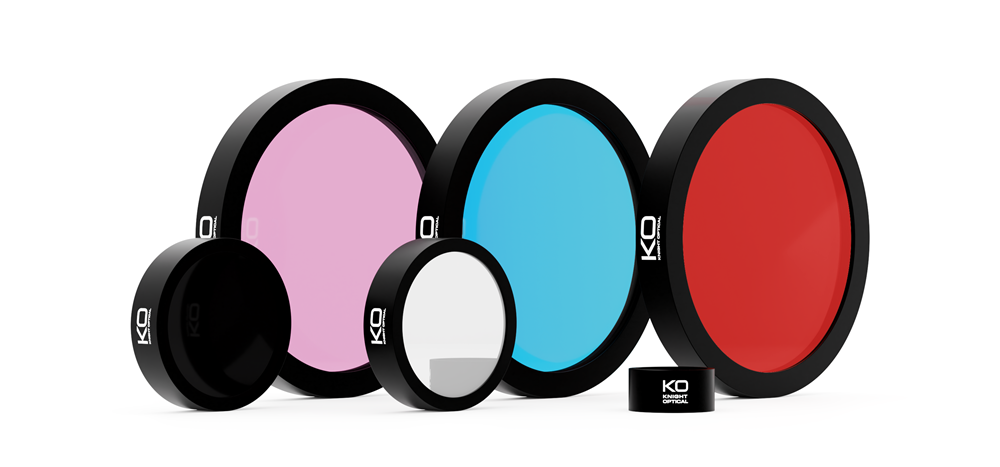
Addressing this challenge starts with spectral control. Interference bandpass filters allow only a specific wavelength range to reach the sensor while blocking unwanted ambient illumination. When matched to a system’s LED light source, they help maintain consistent exposure under changing conditions and improve contrast between the target object and its background, making defects, colour variations, and dimensional irregularities easier to detect.
Different applications require different filter specifications. Broadband filters are suited to environments where maximising light throughput is the priority. Narrowband filters are often preferred where ambient interference is significant. Standard filter configurations are designed to match commonly used LED wavelengths, while UV filters are used to reveal fluorescence and coating layers that cannot be observed with the naked eye, making them valuable in pharmaceutical and security inspection systems.
When inspection reliability suffers
Selecting the wrong bandpass filter can undermine inspection accuracy. Uncertain image data may cause systems to slow down, increase false rejection rates, or allow defective products to pass through the process. In automotive production, a missed weld defect could lead to costly recalls. Within pharmaceutical manufacturing, contaminated blister packs present both regulatory and patient safety risks. In food and beverage processing, overlooked foreign matter can result in product withdrawals and reputational damage. In each case, inspection quality depends on optical performance.
Most engineers involved in specification recognise this connection, but it is sometimes overlooked when optical components are treated as purchasing decisions instead of engineering decisions. A filter that is nearly suitable but not optimised for the real lighting conditions within a facility, can gradually reduce inspection performance. The impact may be difficult to detect during initial validation yet become significant over extended production runs.
Spectral imaging and high-speed sorting
The optical demands become even greater when systems move beyond simple pass/fail inspection and must identify materials at production-line speeds.
In recycling facilities, hyperspectral imaging (HSI) systems monitor conveyor belts moving at speeds of up to 3 m/s, distinguishing polymers such as PET, HDPE, PVC, polypropylene, polystyrene, and ABS through their unique spectral signatures. These signatures are measured within the near-infrared (NIR) and short-wave infrared (SWIR) regions, requiring optics that can deliver clean, consistent spectral data in difficult industrial environments.
Research published by UCL in 2025 demonstrated that HSI could identify contaminated plastic packaging with accuracy rates of up to 99%, highlighting both the capability of the technology and the importance of optical quality in achieving those results.
At such operating speeds, optical components must provide high transmission to ensure sufficient light reaches the detector during short integration periods. Mixed-material surfaces and glossy finishes can introduce flare and unwanted reflections. Bandpass filters designed to isolate the required NIR and SWIR wavebands suppress this interference and improve measurement reliability. The same principles used to stabilise AOI systems are therefore equally important in advanced sorting applications, albeit under more demanding operating conditions.
Durability in continuous operation
AOI systems are expected to operate continuously while being exposed to vibration, thermal cycling, UV radiation, and aggressive cleaning processes. Any deterioration in optical performance directly affects the quality of the inspection data being produced.
Diamond-like carbon (DLC) coatings improve resistance to abrasion in applications requiring regular cleaning or physical contact. Dielectric coatings provide stability when temperatures fluctuate, while protective windows, commonly manufactured from sapphire because of its hardness and optical transmission characteristics, help shield internal optics from dust, debris, and impact damage while preserving optical alignment.
Optical specification as an operational advantage
A properly specified optical system delivers higher-quality image data, more dependable inspection outcomes, reduced false reject rates, and reliable performance throughout the working life of the equipment.

Knight Optical supplies precision optical components for machine vision and automated inspection systems used across manufacturing, food and beverage, pharmaceutical, and recycling applications.
Its range includes interference bandpass filters, protective windows, and custom optical solutions designed for demanding environments, supported by technical guidance to help ensure components are matched to real-world operating conditions.